
One API for local currency in, stablecoins out
Move your users between local currency and stablecoins through 40+ local payment methods, in the markets banks and cards cannot reach.
One integration, 40+ local payment methods
The same rails people already use to move between local currency and stablecoins, now reachable through the API.






















 Lebanon
 Jordan
 Saudi Arabia
 Morocco
 Algeria
 Nigeria
 Ghana
Ghana Côte d'Ivoire
 Ethiopia
 BangladeshLebanonJordanSaudi ArabiaMoroccoAlgeriaNigeriaGhanaCôte d'IvoireEthiopiaBangladeshLebanonJordanSaudi ArabiaMoroccoAlgeriaNigeriaGhanaCôte d'IvoireEthiopiaBangladesh
How a conversion runs
Four calls, one direction or the other. The same flow runs an on-ramp and an off-ramp.
Request a quote
One call returns the rate, the amount out, and how long the rate holds. Set the direction and the two currencies.
The network matches liquidity
A verified counterparty in the local market takes the other side, at the rate the market is actually trading.
Funds sit in escrow
Neither side can move the funds until both sides have paid. There is no window where one party is exposed.
Settle and confirm
Your user receives stablecoins, or local currency on an off-ramp. A webhook confirms so your ledger stays in step.
What the API gives you
One endpoint, both directions
On-ramp and off-ramp through the same call. Set the direction and the currencies.
40+ local payment methods
The methods your users already have, not the ones a card network happens to reach.
Local market rates
Priced by the market that is actually trading, not against a bank reference rate.
A rate that holds
Every quote comes back with a window, so the amount your user sees is the amount they get.
Escrow on every trade
Funds release only once both sides have paid. Neither side can walk away mid trade.
Verified counterparties
Everyone taking the other side of a trade has passed identity checks first.
Non-custodial by default
Keys are generated on the user device. Sinbad never holds or controls user funds.
Local receiving and payout
Collect local currency in-market and pay users out the same way, from a stablecoin balance.
Webhooks
Event callbacks for quote, match, settlement and failure, so your ledger stays in step.
Built for developers. One endpoint to local liquidity.
API infrastructure for on-ramp and off-ramp between local currency and stablecoins. Integrate conversion and local payment coverage into your platform.
Request early accesscurl -X POST "https://api.sinbad.com/v1/quote" \
-H "Authorization: Bearer $SINBAD_KEY" \
-H "Content-Type: application/json" \
-d '{
"direction": "onramp",
"currencyIn": "LBP",
"currencyOut": "USDC",
"amount": "1500000"
}'KYC and AML checks
Counterparties are verified before they can trade on the network.
Secure payments
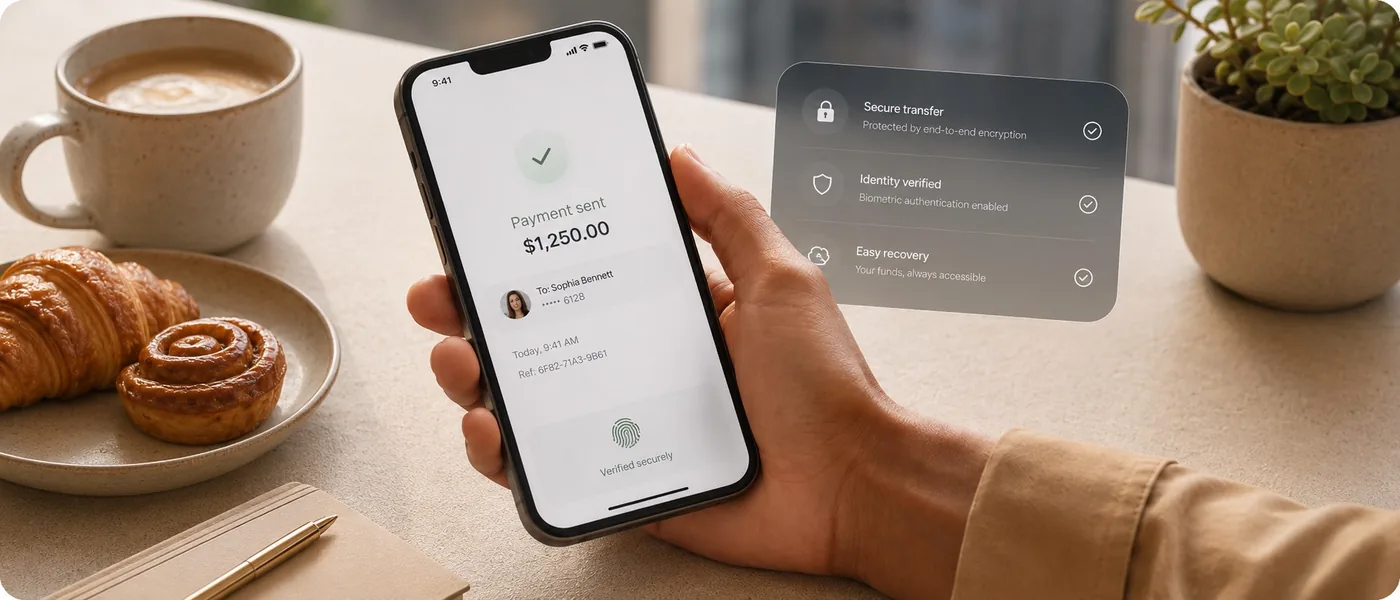
Fully non-custodial wallets
You keep complete ownership of your funds. Sinbad never takes custody.
Modern authentication
Biometric verification and trusted-device recognition on every session.
Easy and secure recovery
Backup options to recover your account if you lose your keys or device.
Escrow trading
Funds are held in escrow until both sides of a P2P trade settle.
Live across the markets banks can't reach.
Local payment methods live across the region, with verified merchants and escrow on every trade.
Frequently asked questions
It moves your users between local currency and stablecoins in both directions, through the local payment methods they already use, from a single set of endpoints.
No.The network is live. The API is in early access and not open to the public yet.